
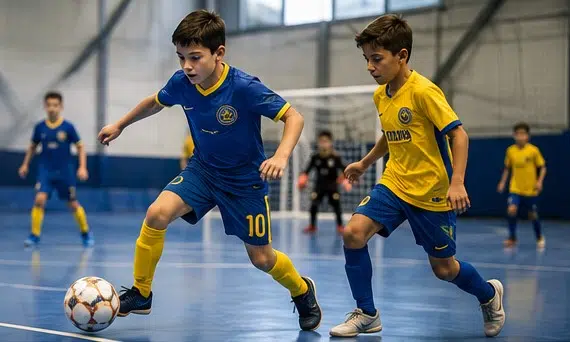
Futsal is a variant of soccer played on a smaller, indoor court, with fewer players and a special ball. Here’s a summary:
What it is It’s played between two teams of 5 players each (including the goalkeeper), on a hard court (usually wood or a synthetic surface) much smaller than a traditional soccer field. The objective is the same: get the ball into the opposing goal.
History It was born in Uruguay in 1930, created by Juan Carlos Ceriani, who was looking for a way to play soccer in smaller spaces like gyms, since traditional soccer fields were often occupied or occasionally flooded. It quickly became popular in South America and later in Europe, especially in Spain and Brazil.
Basic rules
- The court measures between 82-138 ft long and 49-82 ft wide, much smaller than a soccer field.
- Matches last 40 minutes, split into two 20-minute halves, with the clock stopping on certain plays (unlike traditional soccer).
- The ball is smaller and heavier, with less bounce, which favors control and technique.
- There is no offside rule.
- Unlimited «flying» substitutions are allowed (players constantly enter and leave during the match).
- Accumulated fouls lead to a direct free kick with no wall starting from a team’s fifth foul.
Global governing body FIFA regulates futsal internationally and organizes the Futsal World Cup every four years.
Key differences from traditional soccer
- Smaller space → faster, more technical game.
- Greater emphasis on ball control, short passes, and precision plays.
- It’s commonly used as a training method for young players, since it improves technique and decision-making in tight spaces (many stars like Messi and Neymar played futsal as kids).
Why it’s popular It’s ideal for urban spaces, requires fewer players and less equipment, and its intense pace makes it very entertaining to both play and watch.